

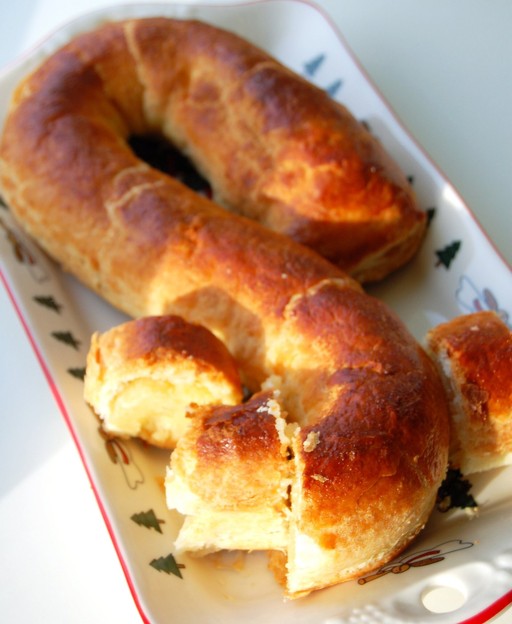
Flaky pastry outside, soft lemony almond paste inside, and bent into the first letter of your name. The Dutch have baked these letters for Sinterklaas since at least the late 18th century, and one family carried the recipe all the way to Iowa.
Free Guide: Dutch Christmas Baking (PDF)
8 Dutch holiday bakes, from kruidnoten to kerststol and oliebollen, in metric and US cups. Free when you join our newsletter.
From banquet to banket
The word banket once meant a feast you sat down to, from a little bench, a bankje. Language historians Hans Beelen and Nicoline van der Sijs, writing in Onze Taal in 2014 and quoted in full on the Etymologiebank, explain how it turned sweet. In the 18th century sugar grew cheaper, and bakers who specialised in sweet things dropped their old name of suikerbakker and called themselves banketbakkers. In Dutch the word banket narrowed further, until it came to mean pastry filled with almond paste. That is exactly what a banketstaaf is.
Letters for Sinterklaas
The same article traces the letters. In 1797 Catharina Zierikhoven described all kinds of “letter-koeken” in her Dutch cookery dictionary, and in her time it became the custom to bake treats in the shape of letters for Sinterklaas, in place of the older amandelbrood. In the 19th century the letters multiplied into new names: banketletter, gevulde letter, boterletter, amandelletter, marsepeinletter and, the one children wanted most, the chocoladeletter. One family story, told by the Carnegie Museum of Natural History, says presents were once laid under a sheet with a dough letter on top to show whose gift was whose. We tell that one as a story.
The letter that went to Iowa
Dutch emigrants settled Pella, Iowa, in 1847. One of them, Harmon Jaarsma, opened a bakery there in 1898 with his family recipes, among them the almond-filled letters he baked in brick ovens, according to the Carnegie Museum‘s account. In Pella they are simply Dutch letters, usually an S, for Sinterklaas. If you have ever bought one at Tulip Time, you have already tasted a banketletter.
A Christmas bake too
Most Dutch December baking is for 5 December, but food historian Christianne Muusers of Coquinaria counts the banketletter among the few traditional Dutch Christmas bakes as well. Most people buy theirs. When she baked one from scratch for Sinterklaas, she admits, a little filling leaked where the seam was not pressed shut: a lesson we have built into the recipe below.
Where to taste it: in Amsterdam, Patisserie Holtkamp lists both a boterletter S and an amandelstaaf in its Sinterklaas range. The shop is at Vijzelgracht 15 and opens Monday to Friday 8:30 to 18:00 and Saturday 8:30 to 17:00 (Holtkamp’s site).
Banketstaaf (Dutch Almond Pastry Log or Letter)
Ingredients
Method
- Make the almond paste the day before: mix the ground almonds, sugar, beaten egg and lemon zest into a firm, smooth paste. Wrap and chill for at least a day. (Using 300 g bought almond paste? Crumble it and work in 1 egg yolk and the lemon zest instead.)
- Heat the oven to 200°C / 180°C fan / 400°F / Gas 6. Line a baking sheet with baking paper.
- On a lightly floured counter, roll the puff pastry into a strip of about 15 x 40 cm (6 x 16 in). On a floured surface, roll the almond paste into an even rope about 35 cm (14 in) long.
- Brush the pastry very lightly with water. Lay the rope along one long side, leaving about 2.5 cm (1 in) of pastry free at each end, and roll it up so the pastry wraps it snugly. Press the seam well and fold in the ends so no paste can leak out.
- Lay it seam-side down on the sheet as a straight log, or bend it gently into a letter (an S for Sinterklaas, or your own initial). Press it slightly flat and brush with beaten egg.
- Prick about 8 small holes along the top, scatter over the flaked almonds if using, and leave to rest for 15 minutes. Brush once more with egg.
- Bake for 25-30 minutes until deep golden and crisp, including the underside. Cool on a rack and slice. It is at its best still a little warm.
Notes
Frequently Asked Questions
What is the difference between a banketstaaf and a banketletter?
Only the shape. Both are puff pastry rolled around a rope of almond paste; the staaf stays straight, the letter is bent into a letter before baking (Koopmans).
Can I use bought almond paste?
Yes. Dutch recipes from 24Kitchen and Koopmans both start from a packet of amandelspijs, loosened with egg (24Kitchen adds lemon zest too).
Why did my almond paste leak out?
Usually the seam or the ends were not sealed firmly enough. Moisten the edges, press them well together and bake seam-side down (Coquinaria).
Sources: Etymologiebank (H. Beelen and N. van der Sijs, “Wie zoet is…”, Onze Taal 2014); Carnegie Museum of Natural History, “Dutch Letters: A Sinterklaasavond Treat”; Coquinaria (Christianne Muusers), traditional Dutch banketletter and almond paste; Koopmans; 24Kitchen; Patisserie Holtkamp. Checked November 2026.
Free Guide: Dutch Christmas Baking (PDF)
8 Dutch holiday bakes, from kruidnoten to kerststol and oliebollen, in metric and US cups. Free when you join our newsletter.
Tours & experiences you might love


Powered by Viator. Some links are affiliate links — we may earn a small commission at no extra cost to you.