

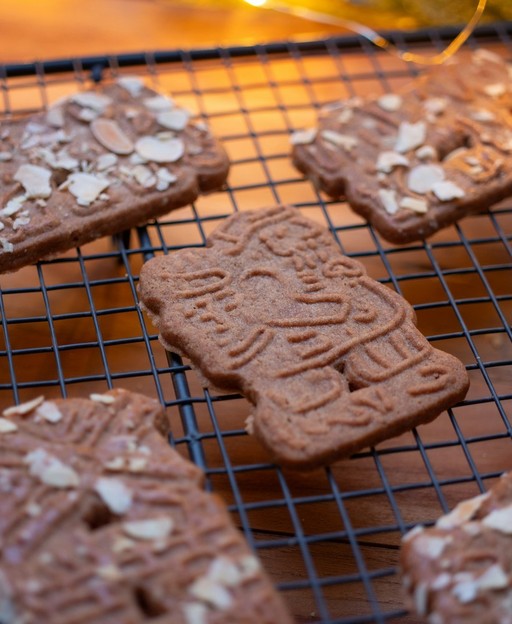
The Dutch have pressed spiced dough into carved wooden boards for centuries, and the biscuit’s own name is still a small mystery. Here is what we know, what is only a story, and a speculaas recipe with a spice mix you can make in any American kitchen.
Free Guide: Dutch Christmas Baking (PDF)
8 Dutch holiday bakes, from kruidnoten to kerststol and oliebollen, in metric and US cups. Free when you join our newsletter.
A biscuit named after a daydream
The oldest Dutch name for the biscuit was not speculaas but speculatie. The Etymologiebank, which gathers the standard Dutch etymological dictionaries, finds the koekebakkers baking “speculatie” in 1749; the form speculaas appears in 1898. Speculatie meant thinking or musing, and in older Dutch also pleasure, as in having your “speculatie” in something. So the name may have meant a treat for people of taste, or simply something fanciful. Belgians say speculoos, from a Brabant way of saying the word, and the German Spekulatius was borrowed from Dutch.
The bishop theory
The story goes that the name comes from the Latin speculator, an overseer and a title for a bishop, so the first speculaas figures would have shown Saint Nicholas himself. It is a lovely idea for a Sinterklaas biscuit. The same dictionary entry quotes P.H. Schröder (1980), who weighed this explanation against two others and found that none of them had enough proof. We like it as a story, not as history.
From klaaskoek to speculaas
Language historians Hans Beelen and Nicoline van der Sijs, writing in Onze Taal in 2014 (quoted in full on the Etymologiebank), trace how the saint’s treats changed. In 1600 Delft banned the stalls that sold sweets on Sint-Nicolaas eve as superstition, yet the treats survived. In the 18th century “klaaskoeken” gave way to speculaasjes and speculaas dolls made to a very similar recipe, and as sugar grew cheaper, sweet baking reached far more homes.
Carved by hand
The pattern is the point. In Leiden, Museum De Lakenhal keeps a carved wooden speculaas board dated 1733, about 50 by 39 cm, with a horseman on one side and a warship and sailor on the back, each marked with the owners’ initials. Dough was pressed into the hollows, scraped flat and knocked out onto the baking sheet, much as you will do with the recipe below.
Where to taste it: at Bakkerijmuseum De Oude Bakkerij in Medemblik, north of Amsterdam, they bake every day, and the café and shop are open Tuesday to Sunday from 11:00 to 17:00. Its collection includes a speculaas board from 1779. Check the museum’s site before you go.
Speculaas (Dutch Spiced Shortcrust Biscuits)
Ingredients
Method
- Make the spice mix: stir the spices together and keep them in a small airtight jar. You need 1 1/2 tablespoons for this batch; the rest keeps for the next one.
- Mix the flour, baking powder, salt, spice mix and sugar in a bowl. Add the cold butter and rub or cut it in until no lumps remain.
- Add the milk and knead briefly to a smooth, firm dough. Flatten it into two discs, wrap and chill for at least 1 hour (or up to a day).
- Heat the oven to 180°C / 160°C fan / 350°F / Gas 4. Line two baking sheets with baking paper.
- With a speculaas board: dust the carved hollows with rice flour or flour, press the dough in firmly, scrape the top flat with the back of a knife, then tap the board on the counter to release the biscuits onto the sheet. Without a board: roll the dough 4 mm (1/8 in) thick and cut shapes with a cookie cutter.
- Bake one sheet at a time for 12-15 minutes, until the edges are firm and a shade darker. Thicker or larger figures need a few minutes more.
- Leave on the sheet for 5 minutes, then cool on a rack. They crisp as they cool.
Notes
Frequently Asked Questions
Is speculaas the same as speculoos?
Same word, different country: speculoos is the Belgian form of the word, from a Brabant way of saying speculaas (Etymologiebank). Dutch speculaas as baked at home for Sinterklaas is made with a full speculaas spice mix of cinnamon, cloves, nutmeg and more.
What is in speculaas spice?
Mostly cinnamon, with cloves, nutmeg, cardamom, ginger and aniseed. Our mix follows the one MAX Vandaag gives: 8 parts cinnamon to 2 each of cloves, nutmeg and cardamom, and 1 each of ginger and aniseed.
Can I make the dough ahead?
Yes. Wrap it airtight and keep it in the fridge for up to a day, then knead it briefly before you use it (Koopmans).
Sources: Etymologiebank (Etymologisch Woordenboek van het Nederlands; Van Dale etymological dictionary; P.H. Schröder 1980; H. Beelen and N. van der Sijs, Onze Taal 2014); Museum De Lakenhal, Leiden, collection no. 1900; Bakkerijmuseum De Oude Bakkerij, Medemblik; MAX Vandaag (spice mixes, 2020); Koopmans baking advice; recipe checked against Dr. Oetker Nederland, 24Kitchen and SBS Food. Checked November 2026.
Free Guide: Dutch Christmas Baking (PDF)
8 Dutch holiday bakes, from kruidnoten to kerststol and oliebollen, in metric and US cups. Free when you join our newsletter.
Tours & experiences you might love


Powered by Viator. Some links are affiliate links — we may earn a small commission at no extra cost to you.