

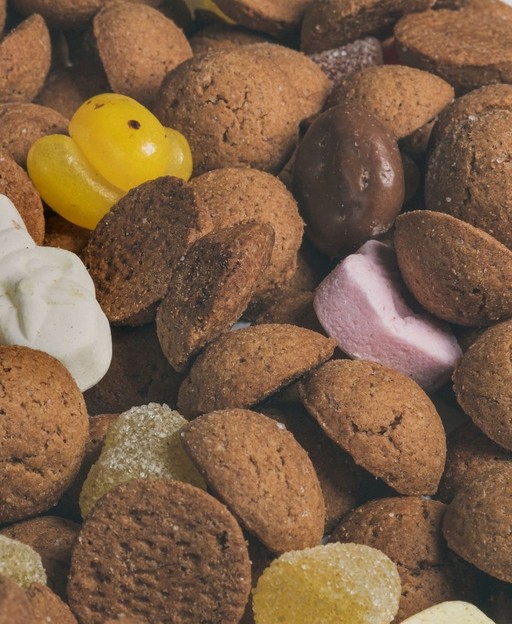
Every November the Dutch buy these little spiced domes by the bag and call them pepernoten. They are kruidnoten, and the mix-up has a story of its own. Here it is, with a recipe that works in an American kitchen.
Free Guide: Dutch Christmas Baking (PDF)
8 Dutch holiday bakes, from kruidnoten to kerststol and oliebollen, in metric and US cups. Free when you join our newsletter.
Two biscuits, one name
Ask a Dutch child what Sinterklaas brings by the handful and you will hear “pepernoten”. What lands in their hands is nearly always a kruidnoot. The language society Onze Taal draws the line in two sentences: pepernoten are little chunks of peperkoek and a bit chewy; kruidnoten are half-domes of speculaas and crunchy. It also admits that the Van Dale dictionary now uses pepernoot for both, so nobody at the table is entirely wrong.
The real pepernoot
The older biscuit is made from rye flour, sweetened with honey and flavoured with anise, cut into rough little cubes with a chew like taaitaai. The Dutch baker Robèrt van Beckhoven explained on MAX Vandaag that real pepernoten come from the same dough as taaitaai: you simply cut it into blocks instead of figures. In Heusden, baker Lucas of Bakkertje Deeg showed Omroep Brabant his method: rye flour, honey and anise, rolled into ropes, chopped, then shaken in a sieve to round off the corners.
Why there is no pepper in a pepernoot
In 1931 the great historical dictionary of Dutch, the WNT, described a pepernoot as a small bake of flour with honey, sugar or syrup, pepper and other spices, about the size of a hazelnut. Onze Taal also quotes an 1872 language journal: pepper was once the spice above all others, so “peper” came to mean any spice at all. That is how peperkoek and pepermunt got their names too. Today most recipes use speculaas spices, which do not always include pepper.
The Zaan bakery that made them crunchy
In 1880 Jan van Delft took over a bakery in Koog aan de Zaan that dated back to 1834, and grew it on breakfast cake, taai-taai and pepernoten. According to the company’s own history, early in the 20th century it was one of the first bakers with a conveyor-belt oven for pepernoten, and the factory-made biscuits came out spicier and crisper. They were a hit across the country. The firm moved to Harderwijk in 1958 and, it says, was the first to make chocolate pepernoten in the 1990s.
From August to 5 December
The chewy original is losing ground. MAX Vandaag reported that the maker Bolletje stopped producing authentic pepernoten in 2017, while kruidnoten go on sale from August every year. The same article dates the custom of throwing them by the handful, strooien, to the 19th century; the story goes that it once stood for fertility. Today it simply means children scrambling across the floor on Sinterklaas evening, 5 December.
Where to taste it: Van Delft, which calls itself the largest pepernoten factory in the world, opens around 20 seasonal shops each year that trade from 1 September to the end of the year (see Van Delft’s site). In Amsterdam, Patisserie Holtkamp on the Vijzelgracht lists pepernoten and kruidnoten as two separate items in its Sinterklaas range: buy a bag of each and taste the difference side by side.
Kruidnoten (Dutch Sinterklaas Spice Biscuits)
Ingredients
Method
- If making your own spice mix, stir all the spices together and keep them in a small airtight jar. You need 2 tablespoons for this batch.
- Mix the flour, sugar, spice mix and salt in a bowl. Add the cold butter cubes and rub or cut them in until the mixture looks like coarse crumbs.
- Add the milk a spoonful at a time and knead briefly to a smooth, firm dough that no longer sticks. Wrap it and chill for 1 hour (or up to a day).
- Heat the oven to 160°C / 140°C fan / 325°F / Gas 3. Line two baking sheets with baking paper.
- Roll the dough into balls of about 5 g each, the size of a hazelnut, and set them on the sheets with a little space between. Press each one lightly with a fingertip so it has a flat base.
- Bake one sheet at a time for 20-25 minutes, until firm and a shade darker. They are still slightly soft when they come out.
- Slide the baking paper straight off the hot sheet onto a rack so the bottoms do not over-bake. The kruidnoten turn crunchy as they cool.
Notes
Frequently Asked Questions
Are kruidnoten the same as pepernoten?
Not strictly. Kruidnoten are crunchy half-domes of speculaas dough; pepernoten are chewy chunks of peperkoek, made with rye and honey. In everyday Dutch, and in the Van Dale dictionary, “pepernoten” now covers both (Onze Taal).
Is there pepper in kruidnoten?
Not always. Most recipes use speculaas spices, which do not always include white pepper. The name comes from an older use of “peper” for any spice (Onze Taal).
My kruidnoten are soft out of the oven. Should I bake them longer?
No. They are still a little soft when baked and turn crisp as they cool. Pull the baking paper off the hot tray straight away so the bottoms do not get too hard, then store them airtight (Koopmans).
Sources: Genootschap Onze Taal (pepernoten / kruidnoten); MAX Vandaag (Robèrt van Beckhoven’s taaitaai and pepernoten, 2017; the difference between kruid- and pepernoten, 2019); Omroep Brabant (Bakkertje Deeg, Heusden, 2018); Van Delft Biscuits company history; Koopmans baking advice; recipe checked against Dr. Oetker Nederland, Verstegen, Ohmydish and King Arthur Baking. Checked November 2026.
Free Guide: Dutch Christmas Baking (PDF)
8 Dutch holiday bakes, from kruidnoten to kerststol and oliebollen, in metric and US cups. Free when you join our newsletter.
Tours & experiences you might love


Powered by Viator. Some links are affiliate links — we may earn a small commission at no extra cost to you.