

Walk down any canal street in Amsterdam and you’ll pass dozens of doors that look like nothing special. Most people walk straight past them. Behind some of those doors lies a world that has barely changed in five centuries.
What Is a Hofje?
A hofje (pronounced HOF-yuh, plural: hofjes) is a courtyard complex built around a central garden. From the 14th century onwards, wealthy Amsterdam merchants built them as charitable housing — mainly for elderly women and religious communities who had nowhere else to go.
The entrance was always deliberate. A plain wooden door. No sign. No invitation. Just a latch you either knew about or you didn’t.
Amsterdam has more than 50 hofjes — far more than any other Dutch city. Most still house residents today. The city never stopped using them.
The Begijnhof — Where It All Began
The oldest and most visited hofje is the Begijnhof, tucked between Kalverstraat and Spui square near the city centre. It dates to the 14th century.
The Begijnhof housed the Beguines — semi-religious women who lived in community without taking formal vows. They cared for the sick, ran their own affairs, and lived outside the formal control of the church.
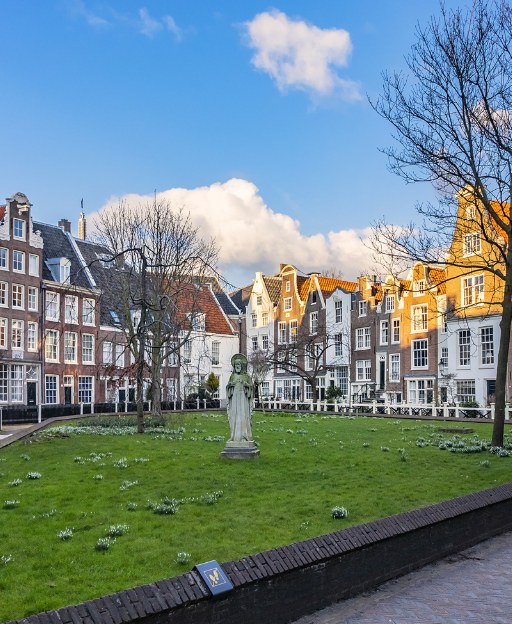
When you step through the low archway, the city disappears instantly. The noise of the shopping streets vanishes. You’re standing in a square of neat Dutch houses surrounding a calm grass lawn. Two historic churches flank the space.
One of Amsterdam’s last surviving wooden houses stands here — number 34, built in 1528. When Amsterdam banned wooden buildings after major fires, this one stayed. Nobody knows exactly why.
The Begijnhof is free to enter. Residents still live there. Visitors are asked to keep their voices low.
The Jordaan’s Secret Courtyards
The Jordaan neighbourhood — built for Amsterdam’s poorest workers — hides most of the city’s lesser-known hofjes behind ordinary-looking doors.
The Sint-Andrieshofje on Egelantiersstraat is one of the most beautiful. Builders completed it in 1614, and its entrance corridor is tiled in classic Dutch blue-and-white Delftware. Step through and you find a small courtyard surrounded by almshouses that have barely changed in four centuries.
The Karthuizerhofje on Karthuizerstraat is one of Amsterdam’s largest. The city built it in 1650 for poor widows. It stretches across the full width of a city block. Locals sit on its benches in summer. Most tourists never find it.
Enjoying this? Get stories like this every week from Love Netherlands — Subscribe free →
How to Visit Without Overstepping
Most hofjes are open during daylight hours. But they’re not tourist attractions — people live here. The rules are simple.
Keep your voice low. Don’t ring doorbells. Don’t peer into windows. Some entrances display a quiet sign: “Enter in silence.” Follow it.
The Begijnhof draws the most visitors and handles them with the most patience. The Jordaan hofjes are quieter — and prefer to stay that way.
If you want to explore more of Amsterdam’s quieter side beyond the famous canals, our Netherlands travel guide has a good starting point for planning your visit.
Why the Dutch Kept Building Them
The hofje tradition tells you something important about how Dutch society worked. Amsterdam’s merchant class got rich fast — faster than almost anywhere in 17th-century Europe. Many chose to spend some of that wealth on the people left behind.
A hofje gave poor women housing, dignity, and a community garden. The merchant got his name on a plaque and a clear conscience. It was a private act of civic generosity that the city absorbed into its fabric without ceremony.
You can read more about the Golden Age city that shaped much of this spirit in our article about the Dutch city ten minutes from Amsterdam that most tourists miss.
Frequently Asked Questions
What is a hofje in Amsterdam?
A hofje is a historic courtyard complex built around a central garden, originally constructed as charitable housing for the poor. Amsterdam has over 50 hofjes, many of which are still inhabited today and open to visitors during daylight hours.
Is the Begijnhof free to visit?
Yes, the Begijnhof is free to enter and open daily. It sits near Spui square in central Amsterdam. Visitors must behave quietly, as residents still live within the complex.
What is the best time to visit Amsterdam’s hidden courtyards?
Weekday mornings are the quietest. Spring is ideal — the courtyard gardens often bloom in April and May, and tourist numbers are lower than in high summer. Aim to arrive before 10am for the most peaceful experience.
Where are the best hofjes in Amsterdam?
The Begijnhof in the city centre is the most accessible. The Jordaan neighbourhood holds the greatest concentration of lesser-known hofjes, including the Sint-Andrieshofje on Egelantiersstraat and the Karthuizerhofje on Karthuizerstraat — both within easy walking distance of the Anne Frank House.
Amsterdam does not give up its best secrets easily. You have to slow down, look for the unmarked door, and be willing to step into a silence that has been here far longer than the city around it.
Love Netherlands — Free Every Week
Canal towns, hidden villages, Dutch stories. A free letter about the Netherlands — written slowly, delivered weekly.
Love more? Join 64,000 Ireland lovers → · Join 43,000 Scotland lovers → · Join 30,000 Italy lovers →
Free forever · One email per week · Unsubscribe anytime
Tours & experiences you might love


Powered by Viator. Some links are affiliate links — we may earn a small commission at no extra cost to you.