

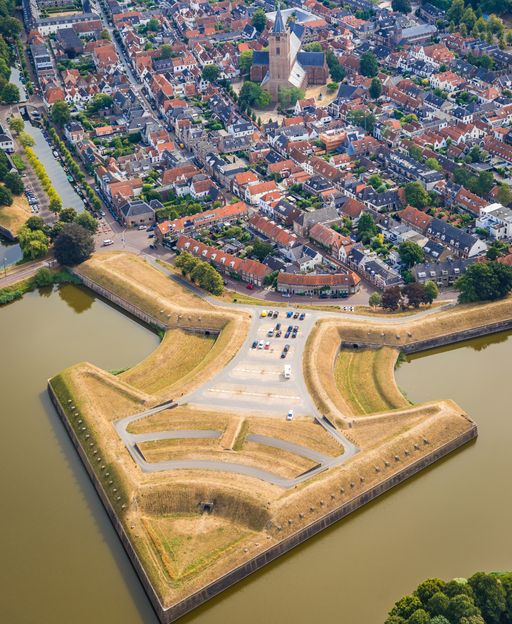
In November 1572, Spanish soldiers entered the town of Naarden and killed almost every person they found. It was one of the worst atrocities of the Eighty Years’ War. Yet today, Naarden stands more perfectly intact than almost any fortified town in Europe — and fewer visitors come each year than walk through Amsterdam’s Rijksmuseum in a single weekend.
A Town That Should Not Have Survived
The Spanish commander Don Fadrique arrived at Naarden’s gates with a simple offer. Surrender, he said, and the town would be spared. The townspeople agreed and opened the gates.
What happened next became known as the Sack of Naarden. Spanish troops killed an estimated 3,000 civilians — men, women, and children — in churches, in the streets, and in their homes. Naarden burned for days.
News of the massacre spread across the Netherlands instantly. William of Orange used it as proof that Spanish rule could never be trusted. It helped unite the Dutch provinces against their occupiers. The war deepened and the Dutch would fight for another 76 years before winning independence.
Amsterdam’s own rise in this same period is a connected story — the city became a refuge for those fleeing exactly this kind of violence, as we explore in why Amsterdam’s most fought-over neighbourhood was built for the poor.
Why the Dutch Built Something Extraordinary Here
After the Spanish finally left Dutch soil, the new Republic faced a hard question. How do you make sure a town can never be taken so easily again?
They built a star fortress.
The design — twelve pointed bastions arranged around a perfect hexagon, surrounded by a wide moat — made direct assault nearly impossible. Cannons on each bastion could cover every angle of approach. Any soldier crossing the moat would face fire from at least two directions at once.
When Napoleon’s engineers surveyed Naarden in the early 1800s, they recommended not attacking it at all. The fortifications were, they concluded, too perfect.
The Dutch built other star forts too — Bourtange in Groningen is another example, and the story of why the Dutch became masters of this style of defence is told beautifully in this look at the Dutch village built like a star. But Naarden is the one that most visitors miss entirely.
Enjoying this? Get stories like this every week from Love Netherlands — Subscribe free →
Walking the Walls Today
Naarden-Vesting — the suffix means “fortress” in Dutch — sits just 25 kilometres east of Amsterdam. By train, it takes under 35 minutes.
From the station at Naarden-Bussum, the approach tells you something is different. You cross the moat on a narrow causeway. The massive earthworks rise ahead. Then you pass through a gate and the town opens up around you.
Inside, the streets are quiet. Around 1,500 people still live within the walls. There are cafes, small shops, and an extraordinary 15th-century church — the Grote Kerk — whose vaulted ceiling carries biblical murals painted in the 1510s.
The most atmospheric attraction is the Nederlands Vestingmuseum, built inside the actual casemats — the tunnels and chambers running beneath the fortress walls. Visitors walk through dark passages where Dutch soldiers once waited, listening for the sound of enemy movement underground.
The Czech Philosopher Who Never Left
Perhaps the strangest thing about Naarden is who is buried here.
Jan Amos Comenius — known in the Netherlands as Komenský — was a Czech philosopher and educator who fled religious persecution in Bohemia in the 1620s. He spent decades moving across Europe, writing about the idea that every child, regardless of background, deserved to learn. He invented the illustrated textbook. He argued for universal schooling 200 years before it became law anywhere.
He settled in Amsterdam in 1656. In 1670, at the age of 77, he died in Naarden.
He is buried in a small Walloon chapel just inside the fortress walls. Czech pilgrims still visit every year — sometimes school groups, because Comenius is regarded in the Czech Republic as the father of modern education. The chapel is simple and quiet. It feels genuinely moving to find this remarkable man resting in a Dutch fortress town that most of the world has never heard of.
The Netherlands has a long history of offering shelter to those the rest of Europe rejected. If you want to understand that quality better, the Start Here page is the best place to begin exploring it.
When to Visit and How to Get There
Naarden is beautiful in every season. Spring brings flowers along the moat banks. Autumn turns the trees inside the walls golden. A weekday morning, before any tour groups arrive, is the ideal time.
By train: From Amsterdam Centraal, take the Sprinter towards Almere and change at Weesp. Naarden-Bussum station is a 15-minute walk from the fortress gate. Allow 30–40 minutes total journey time.
By car: 25 kilometres east of Amsterdam on the A1 motorway. Parking is available just outside the fortress walls.
The fortress walls are freely walkable at any time — no ticket needed. Walking the full circuit of the bastions and looking out over the moat takes around 45 minutes. The Vestingmuseum is open Tuesday to Sunday. Allow two to three hours for a comfortable visit including the church, the museum, and a slow walk around the moat.
What is Naarden in the Netherlands famous for?
Naarden-Vesting is famous for its star-shaped fortress, built in the 17th century after Spanish troops massacred the town’s population in 1572. The fort is one of the best-preserved star fortifications in Europe. The town also holds the grave of Jan Amos Comenius, the philosopher regarded as the father of modern education.
How do I get to Naarden from Amsterdam?
Take the Sprinter train from Amsterdam Centraal towards Almere and change at Weesp. Naarden-Bussum station is a 15-minute walk from the main fortress gate. The total journey takes around 30–40 minutes depending on connections.
Is Naarden worth a day trip from Amsterdam?
Yes, especially if you have already seen Amsterdam’s main sights. The fortress walls are free to walk, the museum inside the casemats is atmospheric and reasonably priced, and the town is never crowded. Allow two to three hours for a relaxed visit.
What happened to Naarden in 1572?
In November 1572, Spanish troops under Don Fadrique entered Naarden after the town surrendered. Rather than honouring the terms, Spanish soldiers killed an estimated 3,000 civilians. The Sack of Naarden became one of the most infamous events of the Eighty Years’ War and directly motivated the Dutch to build the star fortress that still stands today.
Stand on the bastions in the late afternoon, when the light catches the water in the moat, and it is hard to believe this place nearly ceased to exist. Naarden survived. And it remembers.
Love Netherlands — Free Every Week
Canal towns, hidden villages, Dutch stories. A free letter about the Netherlands — written slowly, delivered weekly.
Love more? Join 64,000 Ireland lovers → · Join 43,000 Scotland lovers → · Join 30,000 Italy lovers →
Free forever · One email per week · Unsubscribe anytime
Frequently Asked Questions
What happened to Naarden in 1572?
Spanish troops killed an estimated 3,000 civilians in what became known as the Sack of Naarden, one of the worst atrocities of the Eighty Years' War. News of the massacre helped unite the Dutch provinces against Spanish rule and deepened the conflict for another 76 years.
Why did the Dutch build a star fortress in Naarden?
After the war, the Dutch Republic constructed the fortress to ensure no town could be taken so easily again, with twelve pointed bastions arranged around a perfect hexagon and a surrounding moat making direct assault nearly impossible. The design allowed cannons on each bastion to cover every approach, forcing attackers to face fire from at least two directions at once.
How well preserved is Naarden today?
Naarden stands more intact than almost any fortified town in Europe, with its fortress layout and fortifications fully visible and unchanged from their original design. The town remained so formidable that when Napoleon's engineers surveyed it in the early 1800s, they recommended not attacking it at all.
How crowded is Naarden?
Much less than most Dutch attractions—fewer people visit Naarden annually than tour Amsterdam's Rijksmuseum in a single weekend, despite it being one of Europe's most perfectly preserved fortified towns.
Tours & experiences you might love


Powered by Viator. Some links are affiliate links — we may earn a small commission at no extra cost to you.