

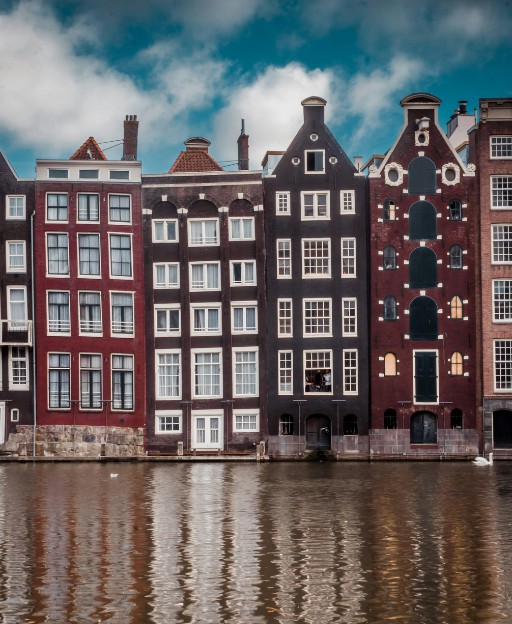
Amsterdam’s canal houses rank among the most recognisable buildings in Europe — tall, narrow and elegantly gabled, they line the city’s historic waterways in a near-unbroken row that has shifted surprisingly little since the Dutch Golden Age. Understanding what you’re looking at, and knowing where to find the finest examples, transforms a stroll along the canals from a pleasant walk into something genuinely revealing. This guide covers the architecture, history and the best places to explore Amsterdam’s famous canal houses.
Love the Netherlands? Join our free newsletter for hidden Dutch gems → inlovewithnetherlands.com/subscribe
Why Amsterdam’s Canal Houses Look the Way They Do
The distinctive silhouette of an Amsterdam canal house — narrow front, deep interior, steep gable — emerged directly from 17th-century economics. Land on the prime canal belt cost money by the front metre, and the city assessed property taxes on street frontage. Merchants built as thin as they could afford (sometimes as little as four or five metres wide) while stretching their buildings deep into the lot, sometimes 20 metres or more from front to back.
The steep pitch of the gables served a practical purpose that’s easy to miss: at the very top of almost every canal house, you’ll spot a hook or pulley beam projecting from the facade. Because builders made staircases so narrow and steep that furniture couldn’t travel up them, workers hoisted everything from wardrobes to barrels of grain through the windows and swung them in from outside. The hook remains on most buildings to this day — one of Amsterdam’s many details that reveal its working, commercial origins.
The Four Main Canal Rings: Where to Go
Amsterdam laid the canal belt in four roughly concentric arcs, each serving a different social and commercial function. Together they form a UNESCO World Heritage Site — a designation UNESCO conferred in 2010, recognising the canal belt as one of the finest examples of planned urban extension anywhere in the world.
Singel
The innermost ring canal, the Singel was the original city moat — dug in the 14th century as Amsterdam’s defensive boundary. When the city expanded outward in the 17th century, the new canal belt absorbed the Singel, and merchants gradually lined its banks with their houses. Today it retains a somewhat quieter character than the grander outer rings, with a series of handsome, tightly packed facades along its southern stretch.
Herengracht (Gentlemen’s Canal)
This is the prestige address — the Herengracht was where Amsterdam’s most successful merchants built their grandest homes. The houses here are wider and more ornate than elsewhere on the canal belt, with sweeping Baroque and Neoclassical facades that speak of serious wealth. The stretch between Leidsestraat and Vijzelstraat is sometimes called the Golden Bend (De Gouden Bocht) and contains some of the most elaborate private residences in the whole of the Netherlands. Walking this section is the best way to appreciate just how prosperous 17th-century Amsterdam was at the height of the Dutch Golden Age.
Keizersgracht (Emperor’s Canal)
The Keizersgracht took its name from the Holy Roman Emperor Maximilian I, and it occupied the second-tier address — wealthy, certainly, but slightly less exclusive than the Herengracht. The result is a more varied streetscape, with fine houses interspersed with former warehouses and more modest facades. For many visitors, the Keizersgracht offers the most photogenic views on the canal belt, partly because its scale feels more human. The canal is also wider than the Singel, with better views across the water to the opposite bank.
Prinsengracht (Prince’s Canal)
The outermost of the three great merchant canals, the Prinsengracht was historically a working canal lined with warehouses, smaller tradespeople’s houses and, eventually, churches and charitable institutions. This mix gives it a more eclectic character. The Anne Frank House sits on the Prinsengracht at number 263, and the Westerkerk — the largest Protestant church in the Netherlands, whose carillon tower Van Gogh could see from his room at the hospital in Saint-Rémy — stands at the canal’s northern end. Houseboats are especially numerous on the Prinsengracht, another layer to the canal’s character.
If you’re planning a longer Amsterdam stay, explore the Jordaan neighbourhood on foot — the area just west of Prinsengracht, with its own network of smaller cross-canals, is one of the most rewarding places to wander in the city.
Gable Types: Reading Amsterdam’s Buildings
The gable forms the front-facing upper section of the facade, and Amsterdam’s builders developed a remarkable variety of shapes over three centuries. Learning to identify them gives the canal walk a whole new dimension.
- Step gable (trapgevel) — the oldest and most widely imitated type, with a staircase-like profile of ascending steps. Common from the late 16th to mid-17th century; often in brick.
- Neck gable (halsgevel) — a narrower upper section with a curved, scroll-shaped connection to the wider lower facade. Popular in the second half of the 17th century and widely considered the most elegant Amsterdam gable type.
- Bell gable (klokgevel) — curved on both sides, giving a bell-like outline. Common from the late 17th century into the 18th century.
- Elevated cornice (rechte kroonlijst) — a straight horizontal cornice across the top, often with decorative detailing; typical of 18th-century Neoclassical-influenced buildings, especially on the Golden Bend of the Herengracht.
- Spout gable (puntgevel) — simple and practical, essentially a triangular point; common on warehouses rather than merchants’ dwellings.
The Leaners: Why So Many Canal Houses Tilt
Look carefully along any stretch of canal, and you’ll notice that a significant number of houses lean forward slightly, towards the street and water. This isn’t structural failure — it’s deliberate. Builders gave houses a gentle forward lean so that goods rising on the pulley hook would swing clear of the lower windows and facade, avoiding damage during loading and unloading. Amsterdam’s building code permitted this lean up to a maximum angle to prevent collapse.
The more worrying tilt you sometimes see — sideways lean, or houses pushing against their neighbours — more often results from subsidence in the peaty, waterlogged ground beneath the city. Builders drove millions of wooden piles deep into the soft soil to support the foundations, and when those piles decay or shift, the buildings above settle unevenly. It’s a reminder that maintaining these historic structures is an active, ongoing challenge for the city.
Inside a Canal House: What You’ll Find
Several canal houses open their doors to the public, giving you a rare chance to see the interiors. The Museum Van Loon on the Keizersgracht (number 672) preserves the interior of a grand 17th-century merchant’s house largely intact, with period furniture, painted ceilings, a coach house and a formal garden. The Willet-Holthuysen Museum at Herengracht 605 is another 17th-century canal house, furnished in the style of the wealthy 19th-century merchants who eventually lived there.
For a broader sweep of Dutch domestic history, the Amsterdam Museum — currently operating from temporary premises while its historic building undergoes redevelopment — covers the full arc of the city’s social history, from the canal belt era through the 20th century.
Where to Find the Best Views and Walking Routes
The most rewarding way to explore the canal houses is to walk, rather than to take a canal cruise or cycle past — though an Amsterdam canal cruise does offer perspectives you can’t get from the towpath, particularly on the width and scale of the canals. On foot, consider these routes.
The Golden Bend (Herengracht, Leidsestraat to Vijzelstraat): the richest concentration of grand Baroque facades on the canal belt. Best in the late afternoon, when the light catches the ornamental gable details.
Brouwersgracht to Singel (northern section): the Brouwersgracht at the northern end of the Jordaan is frequently cited by Amsterdam residents as the most beautiful canal in the city. Short, lined with converted warehouses (the pale upper floors giving them away) and remarkably quiet for such a central location.
Reguliersgracht: a short cross-canal running between Herengracht and Prinsengracht. Famous for its view of seven bridges simultaneously — a classic Amsterdam photograph. Best seen in the early morning or evening when reflections are clearest.
If you want to see Amsterdam’s canal belt from the water, the Start Here guide has practical recommendations on transport, including canal boat options that suit every budget and time constraint.
The Canal Houses Today: Living and Working
Most of Amsterdam’s canal houses still serve as private residences or offices, which is part of what makes the streetscapes feel authentic rather than preserved. They’re working buildings, lived in and occupied, not open-air museums. Owners have subdivided a small number into apartments; others remain single-family homes. The city faces the challenge of balancing the conservation requirements of the UNESCO heritage designation with the practical needs of residents and the pressures of tourism.
Amsterdam runs some of the most active historic building preservation programmes in Europe, with mandatory maintenance inspections and a network of specialist restorers who maintain the facades, gables and foundations. Walking the canal belt in 2026, you’ll regularly spot scaffolding and renovation work — evidence that this extraordinary urban landscape is being actively cared for.
Frequently Asked Questions About Amsterdam Canal Houses
Why are Amsterdam canal houses so narrow?
The city calculated 17th-century property taxes based on the width of a building’s street frontage, which gave merchants a strong financial incentive to build as narrow as possible. The result was tall, deep houses with characteristic thin facades — in some cases as little as four metres wide.
Can you go inside an Amsterdam canal house?
Yes — several historic canal houses are open as museums. The Museum Van Loon at Keizersgracht 672 and the Willet-Holthuysen Museum at Herengracht 605 both preserve historic interiors and are open to the public with paid admission. The Anne Frank House at Prinsengracht 263 is also accessible, though it requires advance booking months ahead in peak season.
Why do Amsterdam canal houses lean forward?
The forward lean was deliberate and legally permitted: goods hoisted on the external pulley hook needed to swing clear of the facade and lower windows to avoid damage during loading. Houses were built at a slight angle for this practical reason. Sideways leans or uneven settling are separate issues caused by subsidence in Amsterdam’s soft, peaty soil.
Where is the best place to photograph Amsterdam canal houses?
The Golden Bend of the Herengracht, the Brouwersgracht in the Jordaan, and the Reguliersgracht (famous for its seven-bridge view) are the classic photography spots. Early morning on weekdays gives you the best light and the fewest people.
How old are Amsterdam’s canal houses?
The great majority of the historic canal houses along Herengracht, Keizersgracht and Prinsengracht were built during the 17th century, Amsterdam’s Golden Age. Some date from the late 16th century, others from the 18th century; the UNESCO World Heritage designation covers the canal belt as built between roughly 1612 and 1750.
You Might Also Enjoy
- The Jordaan, Amsterdam: The Complete Neighbourhood Guide (2026) — exploring the charming streets just west of the Prinsengracht
- Amsterdam Canal Cruise: A Complete Guide to Choosing and Booking — seeing the canal houses from the water
- 3 Days in Amsterdam: The Perfect Itinerary for First-Time Visitors (2026) — how to fit the canal belt into a short Amsterdam trip
Plan Your Netherlands Trip
Ready to start planning? Our Netherlands Start Here guide covers everything from when to visit to how to get around, with practical advice for first-time and returning visitors alike.
Join Netherlands Lovers
Every week, discover the Netherlands beyond the tourist trail — hidden villages, local recipes, cycling routes, and travel insights you won’t find in any guidebook.
Subscribe free — enter your email:
Love more? Join 64,000 Ireland lovers → · Join 43,000 Scotland lovers → · Join 30,000 Italy lovers →
Free forever · One email per week · Unsubscribe anytime
Tours & experiences you might love


Powered by Viator. Some links are affiliate links — we may earn a small commission at no extra cost to you.