
Maastricht stands apart from every other city in the Netherlands. Tucked into the country’s southern tip, squeezed between Belgium and Germany, it has more Roman ruins than Amsterdam, more Michelin stars per resident than almost anywhere else in the country, and a carnival so wild it shuts the city for three days every February. If you have been treating the Netherlands as a quick Amsterdam weekend, Maastricht will quietly make you rethink that plan.
Love the Netherlands? Join our free newsletter for hidden Dutch gems → inlovewithnetherlands.com/subscribe
Why Maastricht Deserves More Than a Day Trip
Most visitors arrive for a single afternoon and leave wishing they had booked two nights. The city rewards slowness. The old town, which the Romans founded as Trajectum ad Mosam (crossing of the Meuse) around 50 AD, packs centuries of history into a walkable core barely a kilometre wide. Medieval city gates stand beside Baroque churches, which stand beside cutting-edge design stores. The café culture — relaxed, southern European in feel — encourages you to sit, order a Limburgse vlaai pastry, and simply watch the world move slowly past.
Maastricht also carries symbolic weight for modern Europe. The Maastricht Treaty, signed in 1992 in the Sint Servaasbasiliek, created the European Union as we know it today. Walk inside that church and you are standing where EU citizenship was born.
Getting to Maastricht
From Amsterdam, Maastricht sits about two and a half hours by direct train. Trains depart from Amsterdam Centraal several times per hour, usually requiring one change at Eindhoven or ‘s-Hertogenbosch. The journey from Rotterdam takes roughly ninety minutes. From Schiphol Airport, allow around two hours including the connection.
Drivers from Amsterdam or Rotterdam will find the A2 motorway runs almost the entire way south. Maastricht Aachen Airport, just outside the city, handles some international routes if you are flying in directly from the UK or elsewhere.
Once you arrive, you need very little else. You can walk the entire historic centre with ease, and the Dutch cycling infrastructure makes exploring the surrounding hills and river meadows by bike entirely straightforward.
The Vrijthof: Maastricht’s Living Room
Every visit begins here. The Vrijthof is a large, elegantly proportioned square flanked by two remarkable churches and ringed with café terraces that fill from late morning onwards on any day the sun appears. In summer, open-air concerts bring orchestras and jazz bands to perform beneath the towers. At Christmas, one of the Netherlands’ most atmospheric markets fills the square with mulled wine stalls and lights.
On the square’s northern edge, the Basilica of Sint Servatius dominates. This is the oldest church in the Netherlands, built over the tomb of Maastricht’s first bishop, who died around 384 AD. The treasury inside holds a remarkable collection of medieval relics, goldwork, and the famous Noodkist — an ornate shrine used to carry the saint’s relics through the city during times of crisis. Admission to the treasure room is worth the small fee.
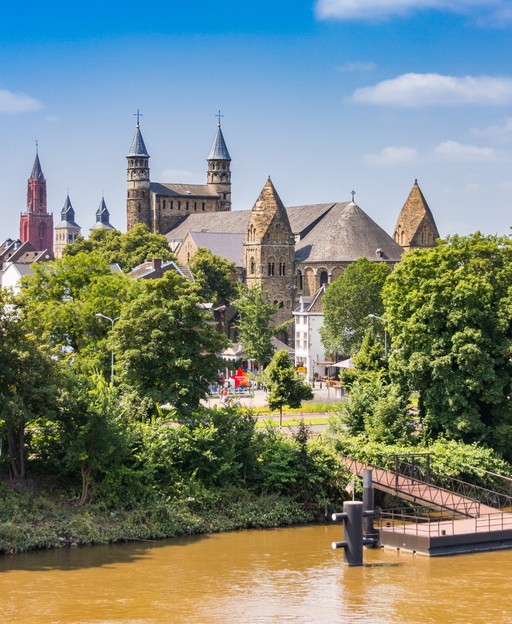
Beside it, the Sint Janskerk (Church of Saint John) rises on a fiery red tower that turns deep crimson in afternoon light. The two churches together, photographed from the south end of the Vrijthof, form one of the Netherlands’ most reproduced skylines.
The Sint Servaas Bridge and the Riverside
Walking south from the Vrijthof brings you down to the Maas. The Sint Servaas Bridge spans the river here — a medieval structure dating to the thirteenth century, making it the oldest bridge in the Netherlands still in use. Walking across it and looking back at the city’s old towers reflected in the water is one of those simple, free pleasures that Maastricht does particularly well.
Developers transformed the east bank of the Maas over recent decades into a relaxed neighbourhood of restaurants, galleries, and terraces. The Bonnefanten Museum — a striking rocket-shaped building designed by Italian architect Aldo Rossi — sits here on the riverfront and houses a strong collection of medieval Flemish art alongside contemporary pieces. It is refreshingly uncrowded compared to Amsterdam’s museum circuit.
Underground Maastricht: The Caves of Sint Pietersberg
Beneath Maastricht lies a world most visitors never discover. Some 20,000 passages honeycomb Sint Pietersberg — the hill rising just south of the city centre — carved by centuries of marl stone mining. These sandstone caves extend for hundreds of kilometres in total length. During the Second World War, the Dutch government hid Rembrandt’s Night Watch and other priceless paintings here for safekeeping.
Guided tours depart from two different entry points — the North Caves and the Zonneberg — and run year-round. The passages stay at a constant 10°C regardless of the season, so bring a layer. The tours last about an hour and cover the wartime history, centuries of carved graffiti left by generations of visitors, and the geological story of a limestone plateau that underpins much of southern Limburg.
At the top of Sint Pietersberg, Fort Sint Pieter overlooks both the Maas valley and the Belgian border on clear days. The eighteenth-century fortifications, built by the Dutch Republic, have been beautifully restored.
Stokstraat and the Old Town Quarter
The Stokstraat runs as the city’s most elegant shopping street — narrow, cobbled, lined with seventeenth-century merchant houses that now shelter independent boutiques, design shops, and chocolatiers. It runs south from the Markt square through the oldest surviving section of the medieval city. Architecture lovers will want to slow down here: watch for the ornate door surrounds, the stone dates carved into lintels, and the occasional courtyard visible through an open gateway.
At the far end, the Helpoort (Hell’s Gate) dates to around 1229 and is the oldest surviving city gate in the Netherlands. The street name itself recalls the city’s medieval gallows, which once stood nearby.
Maastricht’s Food Scene
Limburg has its own food culture, quite distinct from the rest of the Netherlands. The province borders both Belgium and Germany, and three centuries of shifting frontiers produced a cooking tradition that borrows freely from all three. Maastricht has more Michelin-starred restaurants per head than any comparable Dutch city, and eating well is genuinely part of the local culture.
Start with the essentials. Zoervleis is a slow-braised beef stew seasoned with vinegar, juniper berries, and cloves — richly savoury and utterly specific to Limburg. Limburgse vlaai is the province’s answer to the fruit tart: a thin, yeasty pastry shell filled with cherries, apricots, rice pudding, or custard, depending on the baker. Every proper Maastricht bakery carries several varieties, and buying a slice with a coffee is the correct mid-morning plan.
For the full local experience, explore the covered market at the Markt, which runs on Wednesdays and Fridays. For dinner, the streets around the Vrijthof and the Stokstraat quarter carry a dense concentration of restaurants ranging from traditional Limburgse cooking to contemporary European cuisine.
Pair your meal with the Dutch tradition of quality local beer — several Maastricht breweries and many Belgian imports are readily available. The Belgium border is barely a ten-minute drive, so Trappist ales from Chimay and Orval appear on menus as routinely as Heineken does in Amsterdam.
Day Trips from Maastricht
The countryside of South Limburg — rolling hills, fruit orchards, half-timbered farmhouses, and a scattering of hilltop castles — looks nothing like the flat polder landscape most visitors associate with the Netherlands. Hire a bike and explore the Mergelland (Marl Country) to the south and east of the city. The villages of Valkenburg, Gulpen, and Margraten are each worth an hour or two.
Valkenburg, just fifteen minutes from Maastricht by train, has its own cave system, the ruins of a twelfth-century hilltop castle, and one of the Netherlands’ most popular Christmas markets, which runs through November and December inside the town’s marl caves.
Heading west into Belgium takes only minutes. The city of Liège (Luik in Dutch) is thirty kilometres away and offers excellent architecture, a famously lively weekend street market, and the chance to compare what Maastricht’s Belgian neighbours have made of similar history and geography. Many visitors use Maastricht as a base for a loose three-countries mini-itinerary that also dips into Germany’s Aachen, home to Charlemagne’s cathedral, just forty-five minutes by car.
When to Visit Maastricht
The city rewards visits in almost every season, but the peak is summer, when the Vrijthof’s terraces operate at full capacity and the river meadows along the Maas fill with cyclists and walkers. The Netherlands weather guide will help you plan your broader Dutch itinerary, but Maastricht’s southern position means it typically runs a degree or two warmer than Amsterdam and sees slightly less rain.
February brings Carnival — the city’s most famous annual event. Maastricht’s carnival (locally called Vastelaovend) is the largest and most theatrically elaborate in the Netherlands, running for three days before Lent with costumed parades, brass bands, and street celebrations that make the city effectively impassable for anyone not joining in. Book accommodation many months ahead if you plan to attend.
December is spectacular too. The Vrijthof Christmas Market is among the most atmospheric in northern Europe, and the combination of medieval stone, candlelight, and warm glühwein makes it a genuinely memorable winter visit.
How Many Days Do You Need in Maastricht?
One full day covers the Vrijthof, both churches, the Stokstraat quarter, the Sint Servaas Bridge, and a riverside walk. Add a cave tour and a leisurely lunch and you have a rich single-day itinerary. Two nights allows you to add the Bonnefanten Museum, a half-day bike ride into the Mergelland hills, and a proper evening in the old town without rushing. Three days opens up day trips to Valkenburg, Liège, or Aachen, and leaves time to simply wander without a schedule.
Practical Information
The main train station, Maastricht Centraal, sits a ten-minute walk from the Vrijthof. Most hotels cluster in and around the old centre, within easy walking distance of all the main sights. Credit cards are widely accepted, though having some cash for market stalls and smaller bakeries is useful.
Maastricht’s old town is very compact. Park your car at the main P+R car parks on the edge of the centre (clearly signed on the approach roads) and walk or cycle from there. The city restricts driving through the pedestrianised historic core.
Locals speak English widely and well, as in most Dutch cities, so language rarely presents a barrier. That said, locals appreciate any attempt to use a few words of Dutch — or even the local Mestreechs dialect, which is quite different from standard Dutch and a source of fierce local pride.
Frequently Asked Questions About Maastricht
How do I get from Amsterdam to Maastricht?
Direct trains from Amsterdam Centraal offer the fastest and most convenient connection, taking approximately two and a half hours with one change at Eindhoven or ‘s-Hertogenbosch. Trains run several times per hour throughout the day. Driving via the A2 motorway takes a similar time in normal traffic.
What is Maastricht most famous for?
Maastricht gained lasting fame through the Maastricht Treaty (1992), which established the European Union. The city is also celebrated for its well-preserved medieval old town, its vibrant food and restaurant scene (among the best in the Netherlands), the underground marl caves of Sint Pietersberg, and its spectacular carnival celebration every February.
Is Maastricht worth visiting for a day trip?
Yes, a full day gives you enough time to see the Vrijthof, both major churches, the Stokstraat quarter, and the Sint Servaas Bridge, with time for lunch. However, two nights is strongly recommended — it allows you to visit the marl caves, explore the Bonnefanten Museum, and take a bike ride into the Mergelland countryside without rushing.
What is the local food to eat in Maastricht?
The two essential Limburgse specialities are zoervleis (slow-braised sour beef stew seasoned with vinegar and juniper berries) and Limburgse vlaai (a thin yeast-pastry tart filled with cherries, apricots, or custard). Both belong distinctly to Limburg and rarely appear elsewhere in the Netherlands.
You Might Also Enjoy
- Dutch Food Guide: What to Eat (and Drink) in the Netherlands
- Best Time to Visit the Netherlands: A Month-by-Month Guide (2026)
- Gouda Day Trip from Amsterdam or Rotterdam: The Complete Guide
Plan Your Netherlands Trip
Ready to explore more of the Netherlands beyond the tourist trail? Our Start Here guide covers everything from planning your route and choosing the right bases to travelling by train, bike, and car across the country.
Join Netherlands Lovers
Every week, discover the Netherlands beyond the tourist trail — hidden villages, local recipes, cycling routes, and travel insights you won’t find in any guidebook.
Subscribe free — enter your email:
Love more? Join 64,000 Ireland lovers → · Join 43,000 Scotland lovers → · Join 30,000 Italy lovers →
Free forever · One email per week · Unsubscribe anytime
Tours & experiences you might love


Powered by Viator. Some links are affiliate links — we may earn a small commission at no extra cost to you.