

The stairs in the picture never end. The hands draw each other into existence. The water flows uphill, endlessly. These images have baffled millions of people for decades. Yet most of them have no idea the man who made them was Dutch — or that his life’s work now fills a royal palace in The Hague.
The Man Who Turned Maths Into Art
Maurits Cornelis Escher was born in Leeuwarden in 1898, in the flat northern province of Friesland. He studied architecture and decorative arts in Haarlem — but he was never really interested in buildings.
What captivated him was pattern. Repetition. The edges of logic.
He spent much of his early adult life in Italy, filling sketchbooks. A visit to the Alhambra palace in Granada changed everything. The geometric tile patterns of the Moorish craftsmen unlocked something in him. He began making drawings where birds became fish, where one image dissolved into another, where reality folded back on itself.
He was not a mathematician. He was a printmaker. Mathematicians studied his work, wrote papers about it, and invited him to conferences. He would sit there, politely baffled. He once said the mathematics inside his pictures was not something he chose — it was something he found.
A Royal Palace Now Full of Impossible Worlds
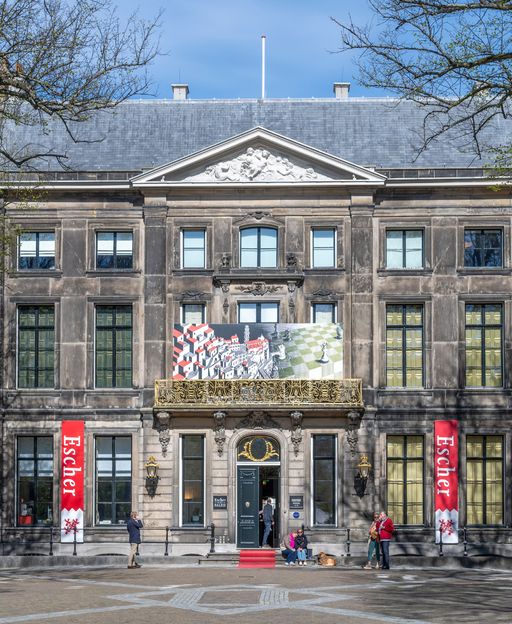
In 2002, the Dutch opened Escher in Het Paleis on the Lange Voorhout in The Hague — Escher in the Palace. The building dates to 1764. Queen Emma lived here. Queen Juliana used it as a guesthouse. The ceilings are high, the rooms are grand, and the walls now carry impossible worlds.
The museum holds around 150 original works. That makes it the largest Escher collection anywhere in the world. You will not find this in Amsterdam. The Hague is where you come.
Something about seeing lithographs of infinite falling water hanging in gilded rooms makes the impossibility feel stranger. The palace does not feel like a gallery. It feels like a secret.
What You Will Actually See
The most famous pieces are all here. Relativity — the staircase print where gravity refuses to pick a direction and figures climb in every direction at once. Drawing Hands — two hands drawing each other into existence, neither one first. Waterfall — water in a perpetual loop that should be impossible.
Beyond the famous works, entire rooms hold tessellations. Flat lizards tile a floor without gaps. Birds flying east gradually become birds flying west. Fish below become birds above.
There is also an interactive section where you can step inside some of the optical tricks yourself. Adults spend more time in front of the prints than they expect. Children never want to leave the interactive rooms.
Enjoying this? Get stories like this every week from Love Netherlands — Subscribe free →
How Escher Fits Into Dutch Art
Escher is often placed alongside Vermeer and Van Gogh as Dutch artists whose work still draws people to the Netherlands. But the three are nothing alike in what they were after.
Vermeer painted the extraordinary inside the ordinary — a girl reading a letter by a window, light falling just so. His world lives in Delft, a small city that still carries his shadow. Van Gogh needed colour to carry feeling. The Dutch countryside shaped him before he ever reached France.
Escher wanted something else. He wanted to show you that the world does not have to follow its own rules. That spirit — curious, disciplined, quietly rebellious — feels very Dutch.
Planning Your Visit to The Hague
The Hague is easy to reach from Amsterdam. Trains run every fifteen minutes from Amsterdam Centraal to Den Haag Centraal. The journey takes around fifty minutes.
The museum sits on the Lange Voorhout — one of The Hague’s grandest tree-lined streets, flanked by embassies and old Dutch townhouses. The walk from the station takes about fifteen minutes, or you can take a tram.
The museum opens Tuesday to Sunday. Allow ninety minutes to two hours. The Mauritshuis museum is a ten-minute walk away and holds Vermeer’s Girl with a Pearl Earring and Rembrandt’s The Anatomy Lesson. Together, the two museums make a full day of Dutch artistic genius in one quiet city.
If you are still planning your Netherlands trip, the Start Here guide covers the best places to begin.
What is Escher in Het Paleis in The Hague?
Escher in Het Paleis is a museum dedicated to the work of Dutch artist M.C. Escher, housed in a former royal palace on the Lange Voorhout. It holds around 150 original works — the largest Escher collection in the world.
Is The Hague worth visiting for art lovers?
Yes. Alongside Escher in Het Paleis, the Mauritshuis holds Vermeer’s Girl with a Pearl Earring and several Rembrandt masterpieces. The city is far quieter than Amsterdam and gives you a day of world-class Dutch art without the crowds.
How do you get from Amsterdam to the Escher museum?
Take the intercity train from Amsterdam Centraal to Den Haag Centraal — it runs every fifteen minutes and takes about fifty minutes. The museum is a fifteen-minute walk from the station, or a short tram ride along the Lange Voorhout.
What are Escher’s most famous works?
His best-known pieces include Relativity (impossible staircases), Drawing Hands (hands drawing each other), and Waterfall (water flowing in a perpetual impossible loop). All three are in the Escher in Het Paleis collection.
Escher never thought of himself as famous. He was a craftsman who made prints. He was surprised by the fame. Standing in a royal palace in The Hague looking at his impossible staircases, it is hard not to think he would have found a certain Dutch irony in all of it.
Love Netherlands — Free Every Week
Canal towns, hidden villages, Dutch stories. A free letter about the Netherlands — written slowly, delivered weekly.
Love more? Join 64,000 Ireland lovers → · Join 43,000 Scotland lovers → · Join 30,000 Italy lovers →
Free forever · One email per week · Unsubscribe anytime
Tours & experiences you might love


Powered by Viator. Some links are affiliate links — we may earn a small commission at no extra cost to you.