
Rotterdam, Netherlands’ second-largest city, surprises almost every first-time visitor. Most travellers arrive expecting a calmer version of Amsterdam and find something completely different: a bold, angular skyline, the largest port in Europe, and a food scene that feels genuinely world-class. Rotterdam earned that boldness the hard way. German bombers destroyed the entire city centre in May 1940 within a single afternoon. What the Dutch built in its place was not a reconstruction but a reinvention — and visiting Rotterdam today means walking through the most architecturally adventurous city in the country.
Love the Netherlands? Join our free newsletter for hidden Dutch gems → inlovewithnetherlands.com/subscribe
Why Rotterdam Feels Unlike Any Other Dutch City
On 14 May 1940, German aircraft destroyed almost the entire historic centre of Rotterdam in a single raid. The Dutch surrender followed the next day. Rotterdammers buried their dead, assessed what remained — a handful of buildings near the old harbour, the port infrastructure, and very little else — and decided not to look back.
City planners and architects chose to build forward rather than recreate what the bombing had taken. Rotterdam became an open laboratory for post-war design, and the experiments never really stopped. Architect Rem Koolhaas grew up here. The city commission continues to approve buildings that other Dutch cities might reject as too strange, too tall or too unconventional. That spirit makes Rotterdam the most honest city in the Netherlands: it looks exactly like what it is — a place that rebuilt itself on its own terms.
The rewards for visitors are immediate. Walking through the centre, you pass buildings that tilt, twist or hover above the street. The density of experimental design is extraordinary, and Rotterdam takes visible pride in it.
The Cube Houses and the Old Harbour
No building in Rotterdam draws more photographers than the Kubuswoningen — the Cube Houses. Architect Piet Blom designed them in the early 1980s, tilting standard cubes 45 degrees and mounting each one on a concrete column above a pedestrian walkway. Each cube represents a tree; the cluster forms an urban forest. From outside, the structures look structurally improbable. From inside, they feel even stranger — every floor tilts at an angle, and the windows cut across corners in ways that make ordinary furniture placement an adventure.
One cube opens as the Kijk-Kubus (Show Cube), allowing visitors to experience the geometry at close range. The Cube Houses sit directly above the Oude Haven — Rotterdam’s oldest surviving harbour basin — which the city lined with historic Dutch vessels in the 1980s. Looking across the water, the Witte Huis watches over the scene from the far quayside. Builders completed the Witte Huis in 1898 using a steel frame, making it one of the first such structures in Europe and the oldest surviving high-rise in the Netherlands.
Spend an hour here in the morning, before tour groups gather. The light on the water and the contrast between the 19th-century white building and the leaning cubes above gives the Oude Haven one of the most distinctive streetscapes in the country.
Inside the Markthal
Rotterdam’s Markthal opened in 2014 and immediately changed the city’s relationship with food. MVRDV architects designed an arch-shaped building where 228 apartments curve around the sides and roof, and the interior vault displays an enormous artwork — “Horn of Plenty” by Arno Coenen — painted across 11,000 square metres of ceiling in vivid colour depicting food, flowers and insects. Entering feels more like walking into a cathedral than a covered market.
Beneath the artwork, around 100 fresh produce stalls, food kiosks and specialist shops fill the ground floor. Vendors sell Dutch herring served with raw onion, stroopwafels still warm from the press, and aged Gouda from cheese merchants who age their wheels on-site. The Markthal sits adjacent to Blaak station and the Cube Houses, making it straightforward to combine all three in a single morning.
Discover more of the Netherlands — join our free weekly newsletter → Subscribe free
Depot Boijmans Van Beuningen
Rotterdam opened the world’s first publicly accessible art storage building in November 2021. The Depot Boijmans Van Beuningen takes the form of a mirrored bowl that reflects the surrounding Museumpark on its curved surface and holds the entire 151,000-piece collection of the Museum Boijmans Van Beuningen. The main museum building closes for major renovation until approximately 2028, and the Depot provides access to the collection in the meantime — though access here means something different from a conventional gallery.
Visitors move through all five floors on a free circular route, watching conservators work through glass-walled studios and seeing artworks stored in their natural conditions rather than arranged for exhibition. Old Masters hang in climate-controlled racks alongside contemporary sculpture and 20th-century design. The rooftop restaurant looks out over the Museumpark and, on clear days, across the city. No other institution in the world offers a comparable experience: a museum where the storeroom is the exhibit.
Delfshaven: The Neighbourhood That Survived
While bombers levelled the city centre in 1940, the old district of Delfshaven remained largely intact. Today it stands as the only neighbourhood in Rotterdam that gives a genuine sense of how the city looked before the war — a quiet stretch of canal lined with 17th and 18th-century warehouses, brick bridges and traditional Dutch gable houses.
Delfshaven carries a specific piece of history for American visitors. In July 1620, a group of English religious separatists — the people later known as the Pilgrim Fathers — sailed from Delfshaven port on the Speedwell, bound for England and eventually for the New World. The Pelgrimvaderskerk (Pilgrim Fathers Church) marks the departure point on the quayside. Beyond the history, Delfshaven has developed a calm neighbourhood feel, with independent cafes, antique dealers and a restored windmill — the Destilleerketel — on the water’s edge.
The Erasmus Bridge and Rotterdam’s Waterfront
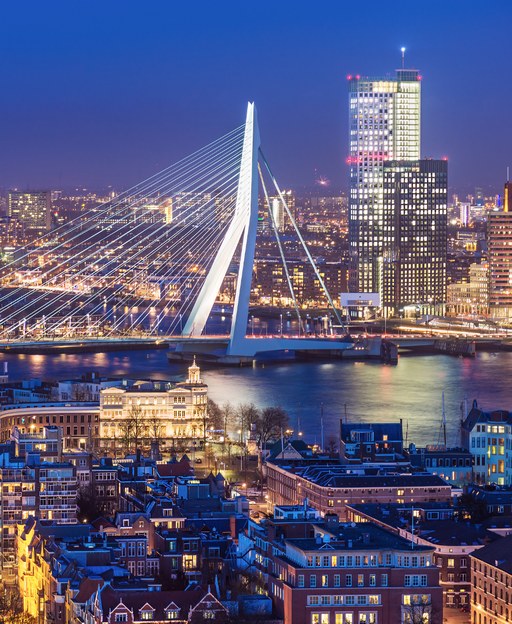
The Euromast tower rises 185 metres from the Museumpark and offers the clearest view of how Rotterdam functions as a city. From the observation platform, the Erasmus Bridge — nicknamed De Zwaan (The Swan) for its single asymmetric pylon — stretches across the Maas below, linking the northern and southern banks. Beyond it, the port extends westward to the sea: cranes, container ships, oil terminals and tankers visible for kilometres. Rotterdam handles more container traffic than any other European port, and the sheer scale of the operation becomes immediately apparent from above.
On the south bank of the Maas, the Katendrecht neighbourhood — once a red-light district, now a creative quarter — houses the Fenix Food Factory, a collective of independent food producers operating from a former warehouse. Craft brewery Kaapse Brouwers pours alongside coffee roasters, an artisan bakery and a cidery. The Waterbus ferry from the city centre crosses to Katendrecht in a few minutes and provides a good view of the Erasmus Bridge on the way.
Day Trips From Rotterdam
Rotterdam sits at the centre of a rewarding cluster of destinations. The Kinderdijk windmills lie around 20 kilometres east of the city, reachable by a direct Waterbus ferry from the Erasmus Bridge. The 19 windmills at Kinderdijk form the largest concentration of historic windmills in the Netherlands and carry UNESCO World Heritage status — the visit takes between two and three hours at a comfortable pace.
Delft sits twelve minutes away by train, offering the Vermeer Museum, hand-painted blue-and-white pottery and one of the most complete medieval Dutch city centres in the country. The Hague is a further fifteen minutes from Delft by train, home to the Mauritshuis gallery and the North Sea beaches at Scheveningen. Combining all three cities in a single South Holland day — Rotterdam in the morning, Delft for lunch, The Hague for the afternoon — makes for one of the most rewarding day-trip circuits in the Netherlands.
Getting to Rotterdam from Amsterdam
Intercity Direct trains connect Amsterdam Centraal to Rotterdam Centraal in around 40 minutes. Standard Intercity services take approximately an hour. Trains depart every fifteen minutes during peak hours, and travellers need no advance booking — tickets are available on the day at any station or via the NS app. Schiphol Airport connects directly to Rotterdam Centraal in around 25 minutes, making Rotterdam a practical base for travellers flying into Schiphol who find Amsterdam hotels expensive or crowded.
Within Rotterdam, trams, metro lines and cycling infrastructure cover the city efficiently. Day hire from any of the central hire stations brings Kinderdijk and Delfshaven within easy cycling distance, and the city marks cycling routes clearly throughout.
Frequently Asked Questions About Visiting Rotterdam, Netherlands
What is the best time to visit Rotterdam in the Netherlands?
Rotterdam works year-round, but the months of April through September bring the most reliable weather for walking and outdoor exploration. May places tulip season within easy reach via the Waterbus to Kinderdijk, and summer weekends bring the Fenix Food Factory and waterfront terraces to life. Winter visits are quieter and often cheaper, with the Markthal providing an excellent refuge on cold days.
How long does it take to travel from Amsterdam to Rotterdam?
The Intercity Direct train from Amsterdam Centraal to Rotterdam Centraal takes approximately 40 minutes. Standard Intercity services take around 60 minutes. Trains run throughout the day, and travellers can purchase tickets on the day at any station or via the NS app — no advance booking is required for standard second-class travel.
Is Rotterdam worth visiting as a day trip from Amsterdam?
Rotterdam makes an excellent day trip, and many travellers find it more engaging than a second day in Amsterdam. A full day allows a comfortable visit to the Cube Houses, Markthal, Depot Boijmans and Delfshaven, with time for lunch at the Fenix Food Factory and a ferry crossing beneath the Erasmus Bridge. Staying overnight opens up the Witte de Withstraat area for evening dining and a morning Waterbus to Kinderdijk before heading back.
You Might Also Enjoy
- Kinderdijk Windmills: The Complete Visitor Guide — 19 UNESCO windmills, 20 km from Rotterdam and reachable by Waterbus
- Dutch Food Guide: What to Eat (and Drink) in the Netherlands — from herring and stroopwafels to stamppot and jenever
- The Hague: Politics, Art, and North Sea Beaches — Rotterdam’s elegant neighbour, twenty minutes by train
Plan Your Netherlands Trip
Ready to explore more of the Netherlands? Our Netherlands travel guide covers everything from where to begin your planning to how to build an itinerary that goes well beyond the tourist trail.
Join Netherlands Lovers
Every week, discover the Netherlands beyond the tourist trail — hidden villages, local recipes, cycling routes, and travel insights you won’t find in any guidebook.
Subscribe free — enter your email:
Love more? Join 64,000 Ireland lovers → · Join 43,000 Scotland lovers → · Join 30,000 Italy lovers →
Free forever · One email per week · Unsubscribe anytime
Tours & experiences you might love


Powered by Viator. Some links are affiliate links — we may earn a small commission at no extra cost to you.