

Travelling the Netherlands by train is one of the great pleasures of visiting this country. The Dutch rail network is fast, frequent, and clean — and it connects almost every place worth visiting, from the grand Victorian terminus of Amsterdam Centraal to the medieval spires of Maastricht, with dozens of remarkable stops in between. Whether you are planning a week-long trip or a single day out from Amsterdam, understanding how the trains work makes everything easier.
Love the Netherlands? Join our free newsletter for hidden Dutch gems → inlovewithnetherlands.com/subscribe
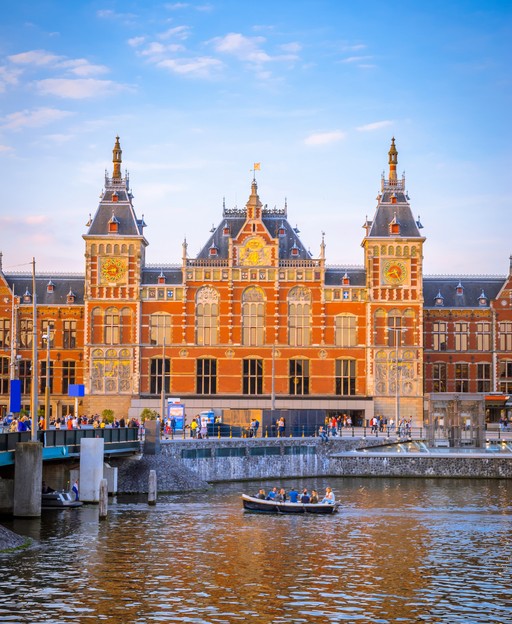
Why the Netherlands by Train Makes Perfect Sense
The Netherlands is one of the most compact countries in Europe. Amsterdam to Rotterdam takes 40 minutes. Amsterdam to Utrecht is just 30 minutes. Even Maastricht, at the very southern tip of the country near the Belgian border, is under two and a half hours from the capital. For visitors accustomed to long drives or expensive domestic flights, this comes as a genuine surprise.
The national rail operator, NS (Nederlandse Spoorwegen), runs a dense network that covers the entire country. Trains run every 15 minutes between major cities during peak hours, and services continue late into the night. There is no need to hire a car if you are sticking to cities and towns — in fact, a car is often more trouble than it is worth in the Netherlands, where parking is expensive and city centres are designed for cyclists and pedestrians rather than drivers.
The OV-Chipkaart: Your Key to Dutch Public Transport
Before boarding a train, you need a way to pay. The standard method in the Netherlands is the OV-chipkaart, a reloadable smart card used across trains, trams, buses, and metro systems. You check in by touching the card to a yellow reader at the start of your journey and check out at the end — the correct fare is deducted automatically.
Anonymous vs Personal OV-Chipkaart
You can buy an anonymous OV-chipkaart from vending machines at any NS train station for around €7.50. Load it with credit at the machine or online, and it works immediately. A personal OV-chipkaart is linked to your name and can be replaced if lost, but requires an address in the Netherlands to register — not practical for most visitors.
For shorter trips, many visitors simply use a contactless bank card or Apple/Google Pay at NS check-in readers. This works well for train journeys but does not always function on local buses and trams, so the OV-chipkaart remains the most versatile option if you plan to explore beyond the main stations.
The NS Day Ticket
If you plan to make several journeys in one day, the NS Day Ticket (dagkaart) offers unlimited train travel across the entire NS network for a flat fee. In 2025 this cost around €32 for a second-class day pass. For a day visiting Rotterdam and Delft from Amsterdam, or looping through Utrecht and Arnhem, this quickly pays for itself. Buy it at any NS ticket machine or through the NS app.
Understanding the Types of Train in the Netherlands
Not all NS trains are the same. Knowing the difference saves confusion on the platform.
- Intercity Direct (IC Direct) — the fastest trains, connecting Amsterdam and Rotterdam in under 40 minutes via Schiphol. Requires a supplement on top of your ticket (currently around €2.60). This is the Thalys/Eurostar corridor train.
- Intercity (IC) — fast trains stopping at major cities only. The backbone of long-distance travel within the Netherlands.
- Sprinter — slower trains stopping at every station. Ideal for shorter hops between nearby towns. No supplement required.
- Intercity International — cross-border services to Belgium, Germany, and beyond. Requires a separate international ticket.
For most journeys within the Netherlands, the standard Intercity is what you want. The Sprinter is useful when your destination is a smaller town not served by IC trains.
Key Train Routes for Visitors
Here are the routes travellers use most often, with approximate journey times from Amsterdam Centraal.
Amsterdam to Rotterdam (40 minutes)
The IC Direct is the quickest option, calling at Schiphol Airport before continuing south. Rotterdam Centraal is itself worth a look — a striking wedge-shaped building opened in 2014. From here, Rotterdam is a walkable city of bold architecture, food markets, and the largest port in Europe. Allow a full day.
Amsterdam to Utrecht (30 minutes)
Utrecht is arguably the most underrated city in the Netherlands. Its canals sit at two levels — street and water — which means the café terraces are built into the canal wharf itself, below street level. Utrecht makes an excellent half-day trip, though many visitors linger longer than planned.
Amsterdam to Haarlem (20 minutes)
Haarlem is often described as what Amsterdam looked like before the tourists arrived. The market square, the Grote Kerk, and the independent shops around the Grote Houtstraat make Haarlem one of the most satisfying short trips from the capital. Sprinter services run every 15 minutes from Amsterdam Centraal.
Amsterdam to Leiden (35 minutes) and Delft (1 hour)
Leiden rewards a few hours with its canals, university corridors, and the Pilgrims’ unexpected Dutch chapter. Continue south on the same line to reach Delft — the city of Vermeer and hand-painted blue pottery that still colours every market stall.
Amsterdam to Maastricht (2 hours 20 minutes)
This is the longest journey on the standard IC network but one of the most rewarding. Maastricht is a different Netherlands entirely — rolling hills replace the flat polder, Burgundian food culture replaces the sober Dutch kitchen, and the street life owes as much to Belgium and France as to Amsterdam. Comfortably done as an overnight trip.
Amsterdam to Groningen (2 hours)
Groningen is the great northern city the Netherlands keeps to itself. A university town with more cyclists than cars, a vibrant food scene, and almost no fellow tourists. The journey runs through the flat agricultural heart of the country — quietly beautiful.
Buying Tickets: NS App, Machines, and Walk-Up Fares
The NS app (available on iOS and Android, fully in English) is the easiest way to plan and buy tickets. You can purchase single or return tickets, check live departure boards, and receive your ticket as a barcode on your phone. It also shows real-time train status, which becomes useful during the Dutch winter when storms occasionally cause delays.
Ticket machines at every station accept bank cards and credit cards, and are available in English. Queues can build at Amsterdam Centraal during peak hours, so the app is worth setting up in advance. Walk-up fares are available — unlike some European rail systems, there is no huge premium for buying on the day in the Netherlands. Prices are distance-based rather than time-of-booking-based.
International tickets to Belgium, Germany, or France require a separate booking. Thalys and Eurostar services to Brussels and Paris depart from Amsterdam Centraal and require advance booking through the respective operators.
Schiphol Airport by Train
Amsterdam Airport Schiphol has its own train station directly beneath the terminal, making it one of the most well-connected airports in Europe. Intercity trains depart every 10–15 minutes to Amsterdam Centraal (17 minutes), Utrecht (37 minutes), Rotterdam (26 minutes), and Eindhoven (1 hour 10 minutes). There is no need to take a taxi or airport bus for most destinations — simply follow the signs to Schiphol Plaza and catch a train.
If you are arriving with heavy luggage, note that Amsterdam Centraal has lifts, but some smaller stations do not. Plan accordingly if mobility is a concern.
Tips for Travelling the Netherlands by Train
- Always check in and out. Forgetting to check out when using an OV-chipkaart results in a penalty charge. Touch the yellow reader on both ends of your journey without fail.
- Platform numbers change. Intercity trains are sometimes reassigned to a different platform at the last minute. Watch the overhead departure boards and listen for announcements — they are given in Dutch and English at major stations.
- Bicycles require a day ticket. You can take a bicycle on NS trains, but you need to buy a separate fietskaart (bicycle day ticket, around €7.50) and avoid peak hours in the morning and evening.
- First class is a modest upgrade. NS first class (eerste klas) is quieter and less crowded but only slightly more expensive on shorter routes. A good option on longer journeys to Maastricht or Groningen.
- Sunday timetables run on some off-peak routes. Services between smaller towns may run less frequently at weekends. Check the NS app before planning a Sunday trip to a smaller destination.
Train Travel Beyond the Cities: Smaller Stations Worth Knowing
Not every memorable Dutch destination requires a major city station. The village of Kinderdijk — home to 19 windmills in a UNESCO-listed polder landscape — is reached via Ridderkerk-Noord station (Waterbus from Rotterdam Erasmusbrug is another option). Zaanse Schans, the open-air windmill village north of Amsterdam, is a short walk from Koog-Zaandijk station, reachable in 17 minutes from Amsterdam Centraal.
For the Keukenhof tulip gardens (open March to May each year), take the train to Leiden Centraal and connect by direct shuttle bus. This is the easiest and cheapest way to reach one of the Netherlands’ most photographed attractions. See the full Keukenhof visitor guide for opening times, ticket prices, and the best weeks to visit.
For further trip planning — including where to base yourself, what to see in each region, and the best time of year to visit — the Start Here page brings together all the guides you need in one place.
Frequently Asked Questions: Travelling the Netherlands by Train
Do I need to book train tickets in advance in the Netherlands?
For domestic NS trains, advance booking is not required — fares are distance-based and walk-up tickets are available at any station machine or through the NS app. Only international trains (Thalys, Eurostar, ICE) require advance booking and may be cheaper when booked early.
Is an OV-chipkaart worth buying for a short visit to the Netherlands?
For visits of three days or more, or if you plan to use trams and local buses as well as trains, the OV-chipkaart is worth the €7.50 purchase cost. For shorter stays focused on a couple of major cities, contactless bank card payment at NS readers is a simpler alternative that works for all NS train services.
How long does it take to travel from Amsterdam to Maastricht by train?
The fastest Intercity trains from Amsterdam Centraal to Maastricht take approximately 2 hours and 20 minutes, with one change at Eindhoven or Utrecht depending on the service. Direct services are also available but slightly slower at around 2 hours 35 minutes. Check the NS app for the current fastest route on your travel date.
Can I use a Eurail pass on Dutch trains?
Yes — the Eurail Netherlands Pass and Global Pass are both valid on NS services, though you may still need to pay a reservation fee for the IC Direct service between Amsterdam and Rotterdam. Eurail passes can be a good value if you are also travelling to Belgium or Germany by train during the same trip.
You Might Also Enjoy
- Day Trips from Amsterdam: The Best Destinations by Train and Bus
- Cycling in the Netherlands: The Complete Guide for Visitors
- 7 Days in the Netherlands: The Perfect First-Time Itinerary
Plan Your Netherlands Trip
Ready to plan your journey? The Start Here page brings together every guide on the site — from where to stay and what to eat, to the best day trips and seasonal highlights. It is the best place to begin.
Join Netherlands Lovers
Every week, discover the Netherlands beyond the tourist trail — hidden villages, local recipes, cycling routes, and travel insights you won’t find in any guidebook.
Subscribe free — enter your email:
Love more? Join 64,000 Ireland lovers → · Join 43,000 Scotland lovers → · Join 30,000 Italy lovers →
Free forever · One email per week · Unsubscribe anytime
Tours & experiences you might love


Powered by Viator. Some links are affiliate links — we may earn a small commission at no extra cost to you.