

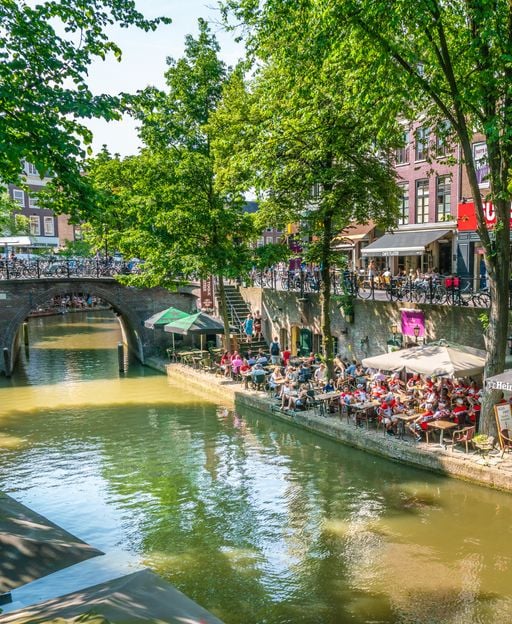
In Utrecht, you can sit at a table, order a coffee, and look straight out at the canal — not from a bridge, not from a boat, but from below street level. You descend a set of stone steps, duck through an arched medieval doorway, and find a terrace right at the water’s edge. This is the werfkelder. It is one of the most extraordinary places to sit in the Netherlands.
The Canal That Doesn’t Follow the Rules
Utrecht’s main canal, the Oude Gracht, is nearly a thousand years old. It runs through the city centre for about 1.5 kilometres. But unlike Amsterdam’s canals — broad and flat, with bridges at street level — the Oude Gracht has two tiers.
Walk along the upper level and you see the water below. Descend a narrow staircase and you reach a lower walkway running directly beside the canal. On one side is the water. On the other are arched doorways cut into the old brick foundations of the city.
These lower walkways are what make Utrecht unlike any other canal city in the world. No other Dutch city has them. Amsterdam does not. Leiden does not. Delft does not.
The Werfkelders: Warehouses That Became Wine Bars
The word “werfkelder” means wharf cellar. Medieval merchants built these stone vaults beneath their townhouses with direct canal access. Goods arriving by boat — grain, salt, wine, cloth — moved straight from water into storage without going up to street level. It was efficient. It was practical. It was medieval logistics at its finest.
For centuries, the werfkelders served as the commercial engine of the city. By the 20th century, the trade had gone. The vaults fell quiet and dark.
Then restaurateurs and café owners discovered something. A stone-vaulted cellar at water level, with an arched ceiling and a terrace opening onto the canal, was about the most atmospheric place in the Netherlands to eat or drink. Today, the werfkelders of the Oude Gracht house some of the finest restaurants and café terraces in the country.
In summer, tables spill onto the narrow stone quays almost to the water’s edge. In winter, the arched interiors glow warm and amber while rain falls on the canal outside.
Enjoying this? Get stories like this every week from Love Netherlands — Subscribe free →
How to Walk the Oude Gracht Properly
Most visitors in Utrecht walk along the upper level — the main shopping street that runs beside the canal. They look down, admire the view, and move on. They miss the best part.
Descend the stone steps at any access point along the canal and walk the lower walkway beside the water. Look for arched doorways and terrace furniture on the narrow stone quays. Allow yourself to stop. The walk from north to south takes about 20 minutes if you don’t pause. Plan for at least an hour.
Where the Werfkelders Concentrate
The stretch between the Ganzenmarkt and the Vredenburg crossing has the highest density of restaurants and bars. The lower walkway is widest here and the terraces most generously spaced.
Later in the day, locals fill these terraces for what the Dutch call borrelen — the ritual of drinks and small snacks shared in good company. The Oude Gracht on a Friday evening is one of the finest expressions of Dutch social life you will find anywhere in the country.
What Else Utrecht Gives You
The Oude Gracht is the reason most visitors come to Utrecht. But the city rewards those who look up as well as down.
The Dom Tower — the Domtoren — is the tallest church tower in the Netherlands. Builders began it in 1321 and finished it in 1382. The nave of the cathedral that connected it to the remaining choir was destroyed in a storm in 1674, which is why the tower now stands alone in the square. It looks deliberate. It was not.
Utrecht is also the Netherlands’ largest university city. Young people and independent cafés fill the streets. The Neude square fills with market stalls at weekends. If you have already explored Amsterdam’s famous Jordaan neighbourhood or the canal streets of Delft, Utrecht offers something different: a city that feels genuinely lived in, where locals still outnumber visitors on a Tuesday afternoon.
If you are planning your first visit to the Netherlands, the Start Here guide will help you build an itinerary that includes Utrecht alongside the country’s other great destinations.
Frequently Asked Questions About Utrecht
What is the best time to visit Utrecht?
Spring (April to May) and early autumn (September to October) offer the best conditions. The werfkelders terraces open fully from April and the city is less crowded than Amsterdam throughout the year.
How do I get to Utrecht from Amsterdam?
Direct trains run every 15 minutes from Amsterdam Centraal to Utrecht Centraal. The journey takes around 27 minutes. Utrecht is one of the easiest and most rewarding day trips in the Netherlands.
Are the werfkelders restaurants expensive?
They range from casual lunch spots to upmarket dinner venues. Budget around €12–18 for a main course at mid-range spots. Booking ahead is advisable at weekends, particularly in summer.
Is Utrecht worth a full day or just a few hours?
A full day is ideal. Walk the Oude Gracht lower level, climb the Dom Tower, explore the university quarter, and sit on a werfkelder terrace for lunch or dinner. Four to six hours covers the essentials comfortably.
Sit on a werfkelder terrace as the afternoon light drops across the canal. Watch the boats pass at eye level. Listen to the city moving on the street above you. Utrecht feels like a secret the Netherlands has been keeping quietly for a thousand years — and sharing with anyone who thinks to look below the surface.
Love Netherlands — Free Every Week
Canal towns, hidden villages, Dutch stories. A free letter about the Netherlands — written slowly, delivered weekly.
Love more? Join 65,000 Ireland lovers → · Join 43,000 Scotland lovers → · Join 30,000 Italy lovers →
Free forever · One email per week · Unsubscribe anytime
Tours & experiences you might love


Powered by Viator. Some links are affiliate links — we may earn a small commission at no extra cost to you.