

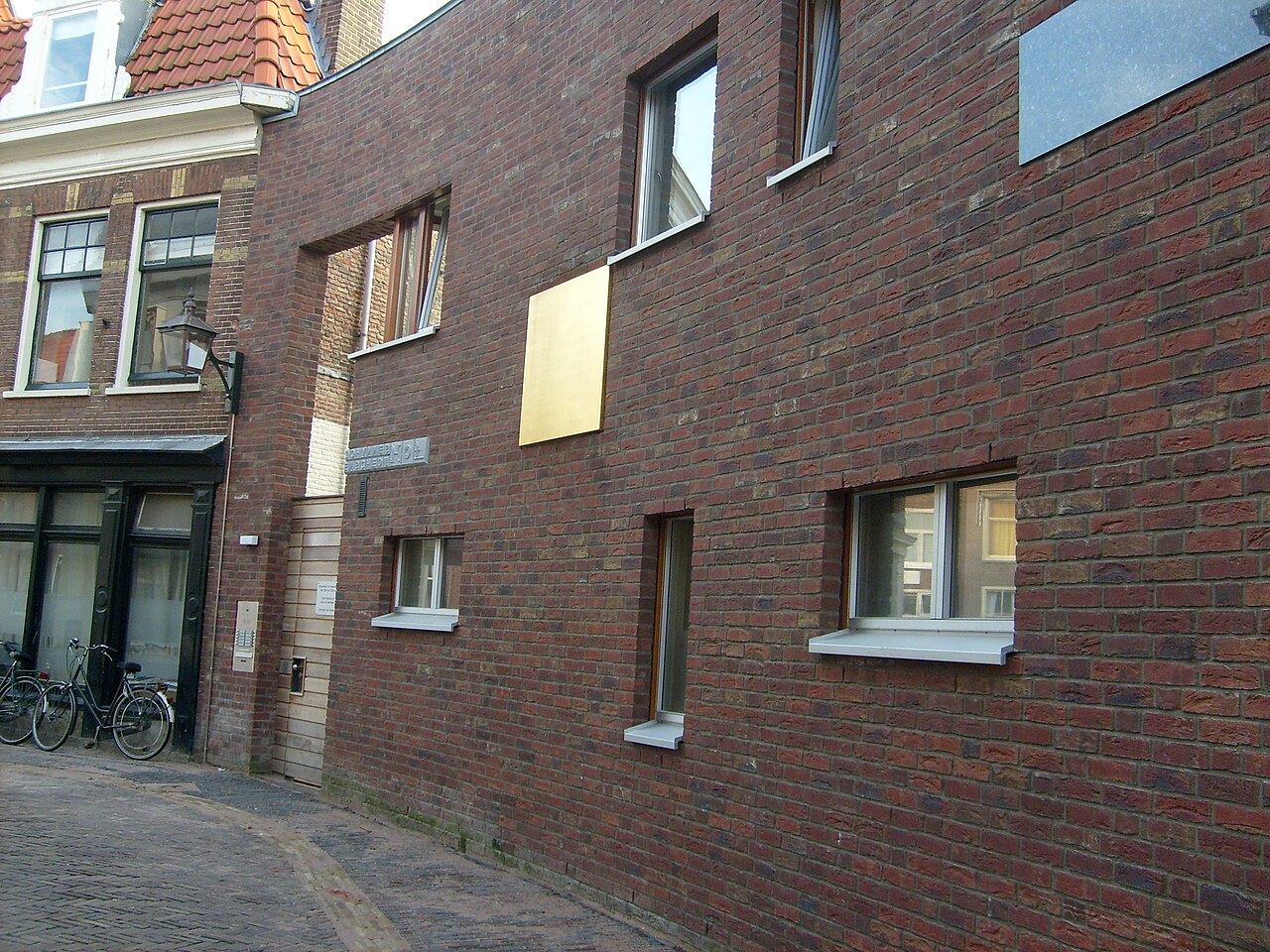
You find the Hofje van Brienen because you are looking for it, or you don’t find it at all. The door sits flush against the Prinsengracht in Amsterdam, a narrow passage between two ordinary townhouses, the kind of entrance you pass thirty times without seeing. There is a small brass plate, verdigris-green, engraved with words so faint they might be a rumour. You knock—or you push; the door is sometimes open—and step into a darkness that lasts perhaps five paces. Your eyes adjust. The passage smells of old brick and boxwood and something like time itself.
Then you emerge.
The courtyard opens before you like a held breath released. It is perhaps forty metres across, ringed by low terraced houses with whitewashed facades and small leaded windows. The gardens in the centre run to neat borders and a few fruit trees, and the whole thing is so utterly quiet, so sequestered from the canal-side roar outside, that you feel you have stepped not just into a different space but a different era. An elderly woman waters a window box. A man sits on a bench reading De Telegraaf. Someone has left a bicycle leaning against a wall. The light is silver-grey, as Dutch light often is, and falls in soft rectangles across the brick.
This is a hofje—or hofje, if we’re being tender about the Dutch pronunciation, which means a small courtyard, though “small” barely captures it. These are among the oldest continuously inhabited social housing schemes in Europe, founded as early as the 14th century by wealthy merchants, regents, and religious confraternities. They were built to house the poor, the elderly, the widowed, the unprotected—those for whom the 16th and 17th centuries offered precious few alternatives. And the remarkable thing is that most of them are still there, still inhabited, still quietly operating under the boards of their original foundations, as if five centuries of social upheaval and the invention of the modern welfare state were merely loud interruptions to a conversation that never actually stopped.
They are, in other words, the Netherlands’ best-kept secret—and perhaps its most vital one.
In Today’s Email
- What a Hofje Is
- The Architecture and Atmosphere
- Five Hofjes Worth Visiting
- Begijnhof, Amsterdam (founded 1346)
- Hofje van Bakenes, Haarlem (founded 1395)
- Sint Annahofje, Leiden (founded 1492)
- Proveniershuis, Haarlem (founded 1591)
- Hofje van Brienen, Amsterdam (founded 1797)
- The Reality of Residence
- The Hofje Today
- The Quiet Continuity
What a Hofje Is
To understand a hofje, you need to understand a particular moment in Dutch social history: the late medieval period, when urbanisation was accelerating, the merchant class was accumulating wealth faster than anyone quite knew what to do with, and the Christian charity imperative ran headlong into the economics of inequality.
By the 14th century, most Dutch cities had a problem. The poor were multiplying—in part because of the very commerce that was making the merchant class rich. Widows whose husbands’ trades had evaporated needed housing. Single women without male protection had almost no legal standing. Elderly people with no children faced destitution. The Church provided some care, but it was sporadic, often brutal, and not sufficient. So the wealthy began to build.
A hofje, at its simplest, was an enclosed courtyard of small houses, built and endowed by a wealthy individual or confraternity specifically to house poor, elderly, or otherwise vulnerable women. (Men occasionally appear in the historical record—the Proveniershuis in Haarlem originally housed old soldiers—but overwhelmingly, hofjes were founded for women.) The founder would deed the property to a board of regents, often prominent citizens, who would oversee its management in perpetuity. The residents—usually widows, spinsters, or devout Catholic women—would live there rent-free or at minimal cost, in exchange for attending chapel services and following strict behavioural codes.
The motives were mixed, as historical motives always are. Some founders were driven by genuine compassion; others sought the spiritual credit that came with visible charity in a deeply Catholic society; still others were moved by vanity—the desire to have their names commemorated on plaques and regents’ room walls. Most were probably some combination of all three. What mattered was the outcome: between the 14th and 19th centuries, hundreds of hofjes were established across the Dutch-speaking territories. Amsterdam has more than two dozen. Haarlem, a city of barely 160,000 today, has seven. Rotterdam, Utrecht, Leiden, The Hague, Gouda—nearly every significant city has at least one, often tucked away behind an unmarked door or down a passage you could walk past for years without noticing.
The economics were elegant. A wealthy merchant or widow would donate capital—usually in the form of land and a building bequest. The regents, who were not paid, would manage the property and the residents. Residents paid nothing or nominal sums; money came from the endowment, from donations, and from whatever small rents the hofje might collect from its properties. This system proved so durable that it survived the Reformation (when many Catholic hofjes were secularised but kept operating), the Golden Age (when new ones were founded), and the industrial revolution. By the 20th century, as the Dutch welfare state expanded, hofjes were no longer the primary means of housing the poor—but they didn’t disappear. Instead, they adapted, continuing to operate as subsidised housing for elderly women, much as they had for 500 years.
It is perhaps the longest-running social housing programme in European history, and it was invented by merchants seeking spiritual credits.
The Architecture and Atmosphere

A hofje is not a grand thing. That is partly its genius. There are no soaring arches, no façades designed to impress. Instead, you find modest terraced houses, usually two or three storeys, arranged in a tight rectangle or sometimes an irregular polygon around a central garden. The houses are small—perhaps three or four rooms—with low ceilings and deep windows. The gardens are practical rather than ornamental: space to dry laundry, to grow vegetables, to sit in the sun when the Dutch weather permits.
What strikes you, standing in one, is the quietness. The outer world is excluded not by walls but by the simple geometry of the courtyard itself. Sound doesn’t travel; the brick and the enclosed space create a buffer. You hear birds, the occasional footstep, the scrape of a window being opened. You don’t hear the city. This was intentional—a deliberate design choice to create a space of refuge, of peace, of separation from the chaos of urban life.
Nearly every hofje has a few standard features. At one corner or along one side, you’ll find the regents’ room—a larger chamber, often decorated with the portraits of the board members who managed the hofje over the centuries. This is where the real story lives. Frans Hals, the 17th-century portrait painter, painted the regents of two Haarlem hofjes near the end of his life—the Proveniershuis and the Hofje van Brienen. He was old by then, possibly impoverished, and he was painting his contemporaries, the men and occasionally women who served on these boards. The paintings are extraordinary: fierce, honest, lined with age and authority. Looking at them—the direct gazes, the practical clothes, the sense of people doing actual work—you understand something about Dutch culture that the canonical paintings of the period don’t quite capture. These were not the rich in their finery; these were the administrators of charity, the keepers of institutions.
Most hofjes also have a chapel or prayer room, often small and simple, sometimes sharing a building with the regents’ room. Services would have been mandatory for residents—a daily or weekly obligation, depending on the hofje’s rules. The chapel was both spiritual centre and mechanism of control; residents were kept pious and orderly through regular devotion.
And then there is the garden, which is perhaps the most important space. Residents would have spent time there—working, sitting, talking to one another. It was their shared world, the place where community happened. Even today, when you walk through a hofje in the afternoon, you’ll often see elderly residents sitting on benches, tending the flowers, moving slowly through the routines that have probably changed very little in centuries.
The whole effect is intimate, intentional, and oddly moving. A hofje is not meant to be impressive; it is meant to be liveable. It is meant to provide dignity, safety, and community—not through grand architecture but through the simple fact of enclosure, of being held.
Continue reading with a Premium subscription
This is a Love Netherlands Sunday Premium guide. Premium subscribers receive the full article in their inbox every Sunday and unlock the full archive of past editions.
Become a Premium subscriber →Tours & experiences you might love


Powered by Viator. Some links are affiliate links — we may earn a small commission at no extra cost to you.